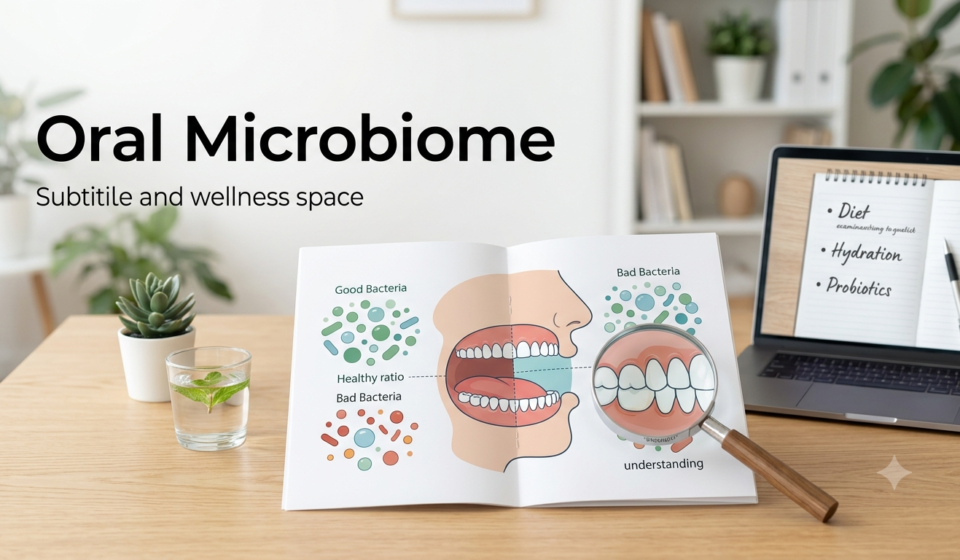

Oral Microbiome: Your mouth has its own microbiome, and it affects more than bad breath. Here’s what disrupts it, how to tell it’s out of balance, and how to support it naturally.
You’ve probably heard of the gut microbiome. Fewer people know their mouth has its own — a distinct community of bacteria, fungi, and other microorganisms that lives on your teeth, gums, tongue, and saliva. Your oral microbiome is one of the most diverse microbial communities in the human body, and it plays a much bigger role in your health than most people realize: it affects bad breath, cavity risk, gum inflammation, and — through the mouth-gut connection — potentially your digestion and immune response too.
This guide covers what the oral microbiome actually is, what throws it out of balance, how to recognize the signs, and what the current evidence says about supporting it.
A chewable oral probiotic built around L. paracasei, L. reuteri, and BL-04. 60-day money-back guarantee.
Check Official Price →What Is the Oral Microbiome, Exactly?
Your oral microbiome is made up of hundreds of different bacterial species living in your mouth at any given time — some estimates put the number at 700+ distinct species identified so far. Most of them are harmless or actively beneficial. A smaller subset are the “bad actors” associated with cavities, gum disease, and bad breath — but here’s the key thing dentistry has increasingly emphasized in recent years: a healthy mouth isn’t one with zero bacteria. It’s one where the beneficial bacteria in the oral microbiome outnumber and out-compete the harmful ones.
This is a meaningful shift from the older “kill all germs” approach that dominated dental product marketing for decades. Harsh antibacterial mouthwash doesn’t distinguish between the bacteria helping you and the bacteria hurting you — it can wipe out both, leaving an empty niche that the more resilient, disease-associated bacteria are often quicker to recolonize.
Read More: ProDentim Side Effects: What to Know Before You Take It (2026)
What Disrupts a Healthy Oral Microbiome
A number of common, everyday factors can throw your oral microbiome out of balance:
- Harsh antibacterial mouthwash used long-term — particularly formulas built around chlorhexidine or high-alcohol content, which are effective short-term but non-selective about which bacteria they kill
- A high-sugar, high-refined-carb diet — sugar is the primary fuel source for the acid-producing bacteria most associated with cavities
- Smoking and vaping — both are linked to a less diverse, less balanced oral microbiome
- Dry mouth — whether from dehydration, mouth breathing, certain medications, or aging, saliva plays a major role in keeping the oral microbiome balanced, so reduced saliva flow removes a natural regulating mechanism
- Antibiotic use — necessary when prescribed, but antibiotics don’t discriminate between the bacteria causing your infection and the beneficial bacteria in your oral microbiome
- Chronic stress — increasingly linked in research to shifts in microbiome composition throughout the body, including the mouth
None of these factors are things to panic about individually — they’re just part of normal life. The issue is usually cumulative: someone with a high-sugar diet, chronic dry mouth, and years of daily antibacterial mouthwash use is dealing with a very different oral microbiome than someone without those factors stacked together.
ProDentim pairs three researched probiotic strains with inulin to help feed them. Try it risk-free with a 60-day guarantee.
🔒 See Today’s Price →Signs Your Oral Microbiome May Be Out of Balance
A few common signals worth paying attention to:
- Persistent bad breath that doesn’t resolve with normal brushing and flossing — often driven by volatile sulfur compounds produced by specific bacteria overrepresented in an imbalanced oral microbiome
- Frequent gum bleeding or inflammation, even with a consistent hygiene routine
- A pattern of new cavities despite good brushing habits and low visible plaque
- A white or coated tongue, sometimes associated with fungal overgrowth (oral thrush) when the oral microbiome’s bacterial population is suppressed
- Recurring mouth sores or a burning sensation, in some cases
None of these are self-diagnostic — a dentist can actually look at what’s going on, and persistent symptoms are worth a dental visit regardless of what you try at home first. But they’re useful signals that your oral microbiome might benefit from more attention than brushing alone provides.
What the Evidence Actually Supports
This is the part most articles on this topic skip past quickly, so it’s worth being specific about what’s actually backed by research versus what’s marketing extrapolation.
Diet matters, and this is well established. Reducing added sugar and refined carbohydrates removes the primary fuel source for acid-producing, cavity-associated bacteria. This is one of the more solidly evidence-backed levers for supporting a healthy oral microbiome — more so than most supplements or products.
Saliva production matters. Staying hydrated, and addressing chronic dry mouth if you have it, supports the oral microbiome’s natural self-regulating mechanisms. Saliva contains antimicrobial compounds and helps physically wash away food debris and bacteria.
Specific probiotic strains have research behind them, though the evidence base is still developing. A handful of bacterial strains — Lactobacillus reuteri, Lactobacillus paracasei, and Streptococcus salivarius K12 among the most studied — have clinical research suggesting they may help reduce gum inflammation, support a more balanced oral microbiome, and in K12’s case specifically, target the bacteria responsible for chronic bad breath. It’s worth being honest that human clinical trials in this space are still relatively limited in number compared to, say, gut probiotic research — the direction of the evidence is promising, not conclusive.
Reducing (not necessarily eliminating) harsh antibacterial mouthwash may help, particularly for long-term daily use, since selective bacterial disruption tends to serve a healthy oral microbiome better than blanket antimicrobial action. This doesn’t mean skipping mouthwash altogether — it means being thoughtful about formula and frequency, and talking to your dentist if you’re using a prescription-strength antibacterial rinse long-term for a reason.
Practical Ways to Support Your Oral Microbiome
Putting the evidence above into a practical routine:
- Cut back on added sugar, especially sipped or snacked throughout the day rather than in one sitting — constant exposure keeps acid-producing bacteria continuously fed
- Stay hydrated and address chronic dry mouth if it’s an ongoing issue for you
- Brush and floss consistently — this remains foundational and isn’t replaced by anything else on this list
- Be thoughtful about long-term antibacterial mouthwash use — check in with your dentist about whether daily use makes sense for your specific situation
- Consider an oral probiotic containing researched strains like L. reuteri, L. paracasei, or S. salivarius K12, taken as a chewable or lozenge so the bacteria make direct contact with your mouth rather than just passing through your gut
- See your dentist regularly — professional cleaning and an actual look at what’s happening in your mouth catches things a home routine can’t
On that fifth point: this is the category ProDentim falls into — a chewable oral probiotic built around L. paracasei, L. reuteri, and B.lactis BL-04, alongside inulin (which feeds the probiotic strains) and a few plant-based ingredients. It’s one option in this category, not the only one, and it’s not a substitute for the fundamentals above — but if you’ve got the diet, hydration, and hygiene basics covered and want to add a targeted oral probiotic on top, it’s worth a look.
Read More: ProDentim Reviews and Complaints 2026 — What Other Articles Are Not Telling You
Frequently Asked Questions
Can you actually reset an unhealthy oral microbiome? “Reset” isn’t quite the right framing — the oral microbiome is dynamic and responds to ongoing habits rather than a one-time fix. Reducing sugar, addressing dry mouth, and being consistent with hygiene over weeks and months shifts the balance gradually rather than instantly.
Do oral probiotics actually work, or is that just marketing? The honest answer is “somewhere in between, and it depends on the strain.” Specific strains like S. salivarius K12 and L. reuteri have real clinical research behind them for specific outcomes (bad breath, gum inflammation). Generic “probiotic” claims without named, studied strains are the part worth being skeptical of.
Is mouthwash bad for the oral microbiome? Not inherently — it depends on the formula and how often you use it. Occasional or targeted use is different from daily long-term use of a strong antibacterial rinse, which is the pattern more associated with disrupting a balanced oral microbiome.
How long does it take to notice a difference? Most of the research on oral probiotic strains and dietary changes shows measurable shifts over several weeks of consistent use, not days — this is a habit-based process, not an overnight one.
The Bottom Line
Your oral microbiome is a living ecosystem, not a surface to be sterilized. The bacteria living in your mouth right now are mostly working for you, not against you — and the goal of a healthy routine is supporting that balance, not wiping the slate clean. Diet and hydration are the most evidence-backed levers, consistent hygiene remains non-negotiable, and targeted oral probiotics with researched strains are a reasonable add-on for people who want to go a step further. If persistent bad breath, gum bleeding, or new cavities are part of your picture despite a solid routine, that’s worth a conversation with your dentist rather than something to solve through diet or supplements alone.
This article is for informational purposes and reflects general, publicly available research on the oral microbiome. It is not medical or dental advice. Consult a dentist or doctor about persistent symptoms or before making significant changes to your oral care routine.
Disclosure: This article contains affiliate links. If you buy through them, we may earn a commission at no extra cost to you. See our full Affiliate Disclosure. This is not medical advice — see our Disclaimer.