Sunday Night Insomnia: Why You Can’t Get Comfortable in Bed & Quick 10-Minute Sleep Hacks

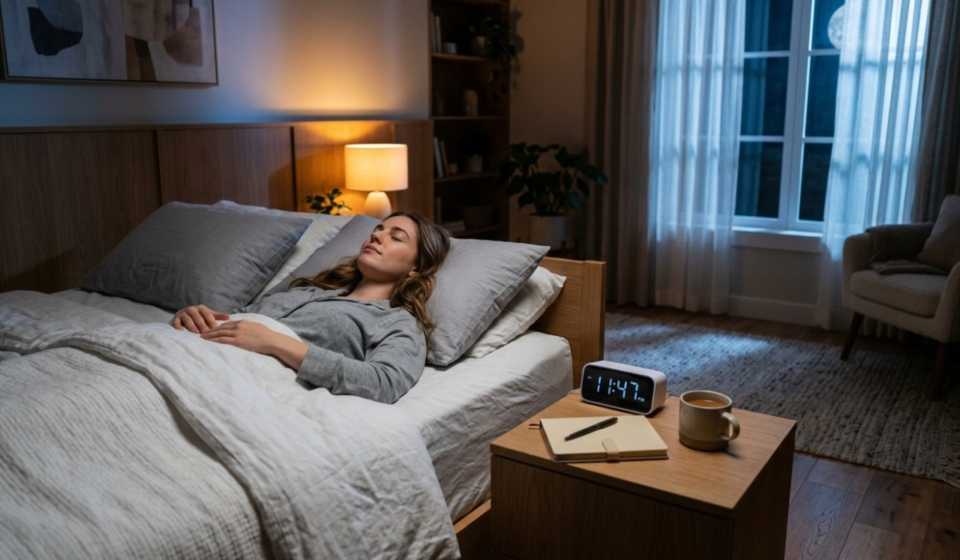
Sunday night insomnia is one of the most frustrating sleep problems in modern life. The weekend was supposed to recharge you, yet here you are at 11:47 p.m. on a Sunday, flipping your pillow to the “cool side” for the fifth time, adjusting your blanket, stretching your legs, and staring at the ceiling. Monday is already looming, and the harder you try to sleep, the more awake you feel. If this sounds familiar, you are not alone — and more importantly, you are not broken.
In this comprehensive guide, we will break down exactly what Sunday night insomnia is, the science behind why it happens, why you literally cannot get comfortable in bed, and the fastest 10-minute sleep hacks that actually work. By the end, you will have a practical Sunday night sleep routine that can change your entire week.
Table of Contents
What Is Sunday Night Insomnia?
Sunday night insomnia is a specific form of situational insomnia that occurs on Sunday nights, typically before the work or school week begins. It is sometimes called the “Sunday scaries” or “Sunday night blues,” but clinically it is a real sleep disruption pattern. Your body and mind are transitioning from a relaxed weekend schedule into a structured weekday schedule, and that transition creates a physiological and psychological conflict.
Sunday night insomnia is not usually a chronic sleep disorder. It is more of a conditioned response — your brain has learned that Sunday night equals anxiety, anticipation, and pressure. Over time, this becomes a self-fulfilling prophecy: you expect to sleep badly, so you do.
Quick Facts About Sunday Night Insomnia
- It affects millions of people worldwide, especially working professionals aged 25–55.
- It is strongly linked to “social jet lag” — the mismatch between weekend and weekday sleep schedules.
- It often peaks between 10 p.m. and 2 a.m.
- It can trigger a domino effect that ruins your entire Monday and even the whole week.
- It is highly treatable with behavioral changes and sleep hygiene adjustments.
Why Sunday Night Insomnia Happens: The Science Explained
To fix Sunday night insomnia, you must first understand why it happens. There are several overlapping causes.
1. Social Jet Lag (Weekend Schedule Drift)
If you sleep in until 10 a.m. or 11 a.m. on Saturday and Sunday, your internal body clock shifts later by 1–3 hours. This is called social jet lag. By Sunday night, your circadian rhythm still thinks it is “Saturday night mode,” so your brain does not release melatonin at the normal time. You go to bed at 11 p.m., but your body thinks it is 9 p.m.
2. Anticipatory Anxiety and the Monday Mindset
The human brain is a prediction machine. On Sunday evening, it starts simulating Monday: the meetings, the deadlines, the emails, the commute, the difficult conversation with your boss. This anticipatory anxiety activates your sympathetic nervous system — your fight-or-flight response. Your heart rate rises slightly, cortisol increases, and your body becomes physiologically aroused. Arousal is the enemy of sleep.
3. The “Revenge Bedtime Procrastination” Trap
Many people stay up late on Friday and Saturday as a form of revenge bedtime procrastination — reclaiming personal time they feel deprived of during the workweek. This delays sleep further and worsens the Sunday night crash.
4. Caffeine and Alcohol Residue
Weekend coffee dates, afternoon lattes, energy drinks, and alcohol all have long half-lives. Caffeine can stay in your system for 6–10 hours. Alcohol may help you fall asleep, but it fragments sleep in the second half of the night, causing awakenings and restlessness.
5. Conditioned Insomnia
If you have experienced Sunday night insomnia for several weeks, your brain has now associated your bed with frustration and wakefulness. This is called conditioned insomnia. The bed becomes a trigger for anxiety rather than relaxation.
Why Can’t I Get Comfortable in Bed? The Real Reasons
This is one of the most searched questions on Sunday nights, and the answer is more complex than “your mattress is bad.” When you have Sunday night insomnia, your discomfort is often neurological, not just physical.
1. Hyperarousal Keeps Your Body Tense
When your nervous system is in a state of hyperarousal, your muscles remain subtly contracted. You may not notice it consciously, but your shoulders, jaw, neck, and lower back stay engaged. This makes it impossible to find a “comfortable” position because your body is not actually relaxed.
2. Temperature Dysregulation
Your core body temperature must drop by about 1–2°F for sleep to occur. Anxiety and stress can interfere with this thermoregulation. You may feel too hot, then too cold, then too hot again. You throw off the blanket, pull it back, flip the pillow — and the cycle continues.
3. Sensory Sensitivity Increases at Night
At night, when there is less external stimulation, your brain amplifies internal sensations. The tag on your shirt feels scratchy. The sheet wrinkle feels like a rock. Your heartbeat feels loud. This is a normal neurological phenomenon called sensory amplification, and it is worse when you are anxious.
4. The Paradox of Trying to Sleep
Sleep is a paradoxical state: the harder you chase it, the more it runs away. When you desperately try to get comfortable and force sleep, you activate the arousal system. This is why “trying” to sleep is counterproductive.
5. Poor Pre-Bed Routine
If you spend Sunday evening scrolling on your phone, watching intense TV, eating heavy food, or arguing about finances, your body enters bedtime already dysregulated. You cannot expect comfort when your nervous system is still in overdrive.
6. Undiagnosed Physical Issues
Sometimes Sunday night insomnia and the inability to get comfortable are worsened by real physical conditions: restless legs syndrome (RLS), acid reflux, sleep apnea, hormonal changes, chronic pain, or fibromyalgia. If your discomfort is severe and persistent, consult a doctor.
The Sunday Night Insomnia Cycle (And Why It Gets Worse)
Here is how Sunday night insomnia typically becomes a weekly pattern:
- Sunday morning: You sleep in late, shifting your circadian rhythm.
- Sunday afternoon: You feel a subtle dread about Monday.
- Sunday evening: You try to go to bed early to “catch up,” but your body is not ready.
- Sunday 11 p.m.–2 a.m.: You lie awake, tossing and turning, frustrated.
- Monday morning: You wake up exhausted, groggy, and irritable.
- Monday night: You are overly tired, so you crash early — reinforcing a new cycle.
- Next Sunday: The pattern repeats, often worse because you now expect it.
Breaking this cycle requires a combination of behavioral strategies, sleep hygiene, and quick in-the-moment hacks.
A written protocol that turns evidence-based techniques into a night-by-night plan — instead of trying to remember all 12 from scratch. 60-day guarantee.
See the Full System →Quick 10-Minute Sleep Hacks for Sunday Night Insomnia
These are fast, practical, and scientifically grounded techniques you can use tonight. They are designed to work in about 10 minutes or less.
These are fast, practical, and scientifically grounded techniques you can use tonight. [For the full neuroscience-backed protocol to quiet an overactive brain, read our 5-step sleep hacking guide → Link
Hack 1: The 10-Minute “Cool Body” Reset (Minutes 0–10)
Your core temperature must drop for sleep. Do this:
- Take a warm shower or bath for 5–7 minutes. The warm water draws blood to your skin, and when you step out, your core temperature drops rapidly.
- Keep your bedroom between 65–68°F (18–20°C).
- Use breathable cotton or bamboo sheets.
- If you are already in bed, try the “cool pillow flip” and place a cold pack or chilled towel on your wrists and neck for 2 minutes.
This hack alone can reduce sleep onset time significantly.
Hack 2: The 4-7-8 Breathing Technique (5 Minutes)
Developed by Dr. Andrew Weil, this technique activates the parasympathetic nervous system.
- Inhale through your nose for 4 seconds.
- Hold for 7 seconds.
- Exhale slowly through your mouth for 8 seconds.
- Repeat 4 cycles.
This lowers heart rate and reduces hyperarousal. Do it while lying in bed with your eyes closed.
Hack 3: Progressive Muscle Relaxation (PMR) in 8 Minutes
Starting from your toes and moving upward:
- Tense each muscle group for 5 seconds.
- Release for 10 seconds.
- Notice the contrast.
Go through your feet, calves, thighs, glutes, abdomen, chest, arms, hands, shoulders, neck, and face. This releases the subconscious tension that makes you feel uncomfortable in bed.
Hack 4: The “Cognitive Shuffle” (10 Minutes)
This technique from Dr. Luc Beaudoin interrupts racing thoughts. Think of random, unrelated images in sequence: a dolphin, a pencil, a cloud, a bicycle, a candle. Do not let your mind settle on any one thought. This mimics the micro-dreams of sleep onset and helps you drift off.
Hack 5: The 10-Minute “Worry Window” Before Bed
Set a timer for 10 minutes at 8 p.m. or 9 p.m. Write down every worry about Monday. Then write one small action step for each. Close the notebook and say, “I have handled this on paper. I will not handle it in bed.” This is a form of cognitive offloading and it works remarkably well for Sunday night insomnia.
Hack 6: The “Body Scan + White Noise” Combo
Play brown noise, pink noise, or rain sounds at low volume. Simultaneously do a body scan from head to toe, noticing sensations without judgment. The white noise gives your brain a neutral anchor, reducing sensory amplification.
Hack 7: The 10-Minute “Reset Your Clock” Trick
If you cannot sleep after 20 minutes, get out of bed. Go to another room with dim light. Read a boring book or do gentle stretching for 10 minutes. Return to bed only when sleepy. This prevents your bed from becoming a battlefield.
Hack 8: Legs-Up-The-Wall Pose (5 Minutes)
Lie on your back and put your legs up against a wall at a 90-degree angle. This calms the nervous system, improves circulation, and reduces restlessness. It is especially helpful if you have restless legs or lower back tension.
Hack 9: The “Sunday Night Shower + Stretch” Ritual
Combine a warm shower with 5 minutes of gentle yoga: child’s pose, cat-cow, forward fold, and supine twist. This lowers cortisol and prepares the body for rest.
Hack 10: The “Digital Sunset” Rule
Turn off all screens 60 minutes before bed. If you must use your phone, enable night mode and reduce brightness to the minimum. Blue light suppresses melatonin by up to 50%.
The Ultimate Sunday Night Sleep Routine (Hour-by-Hour)
To truly defeat Sunday night insomnia, build a structured Sunday routine.
Sunday Morning (7–9 a.m.)
- Wake up at your normal weekday time. Do not sleep in more than 30 minutes.
- Get 10–15 minutes of sunlight exposure.
- Eat a protein-rich breakfast.
Sunday Afternoon (12–4 p.m.)
- Avoid caffeine after 2 p.m.
- Do light exercise or a walk.
- Avoid long naps. If you must nap, keep it under 20 minutes before 3 p.m.
Sunday Evening (6–9 p.m.)
- Eat dinner by 7 p.m. Keep it light.
- Avoid alcohol.
- Do the 10-minute worry window at 8 p.m.
- Prepare Monday’s clothes, bag, and meals to reduce anticipatory anxiety.
Sunday Night (9–11 p.m.)
- Digital sunset at 9:30 p.m.
- Warm shower at 10 p.m.
- Gentle stretching or reading.
- 4-7-8 breathing in bed.
- Lights out by 11 p.m.
Sleep Hygiene Rules for Sunday Night Insomnia
- Keep your bedroom cool, dark, and quiet.
- Use blackout curtains and earplugs if needed.
- Reserve your bed for sleep and intimacy only.
- Avoid clock-watching. Turn the clock away from you.
- Keep a consistent wake-up time every day, even weekends.
- Limit alcohol and caffeine.
- Exercise regularly, but not within 3 hours of bedtime.
- Manage stress with journaling, therapy, or meditation.
- Get sunlight early in the day to anchor your circadian rhythm.
When to See a Doctor About Sunday Night Insomnia
If your Sunday night insomnia persists for more than three months, occurs more than three nights per week, or causes significant daytime impairment, you may have chronic insomnia disorder. Cognitive Behavioral Therapy for Insomnia (CBT-I) is the gold-standard treatment. It is more effective than sleeping pills long-term.
Also see a doctor if you experience:
- Loud snoring or gasping (sleep apnea)
- Restless legs or periodic limb movements
- Severe anxiety or depression
- Chronic pain
- Acid reflux or breathing issues
Frequently Asked Questions
What is Sunday night insomnia?
Sunday night insomnia is difficulty falling or staying asleep on Sunday nights, usually caused by social jet lag, Monday anticipatory anxiety, and poor pre-bed habits.
Why can’t I get comfortable in bed on Sunday nights?
Because hyperarousal, temperature dysregulation, sensory amplification, and conditioned anxiety keep your nervous system activated. Your body is not truly relaxed, so no position feels right.
How do I stop Sunday night insomnia fast?
Use the 10-minute hacks above: cool body reset, 4-7-8 breathing, progressive muscle relaxation, cognitive shuffle, and the worry window. Consistency matters more than perfection.
Is Sunday night insomnia a real disorder?
It is not a standalone diagnosis, but it is a recognized situational insomnia pattern. If it becomes chronic, it may meet the criteria for insomnia disorder.
Should I go to bed early on Sunday?
No. Going to bed early when your body is not sleepy can worsen Sunday night insomnia. Stick to your normal bedtime.
Does melatonin help Sunday night insomnia?
Melatonin can help reset your circadian rhythm if taken 1–2 hours before bed, but it is not a cure for anxiety-driven insomnia. Use it cautiously and consult a doctor.
Why do I feel uncomfortable in bed even when I’m tired?
Because tiredness and sleepiness are different. You can be physically tired but neurologically aroused. This mismatch causes restlessness and discomfort.
Final Thoughts: Take Back Your Sunday Nights
Sunday night insomnia is not a life sentence. It is a predictable, understandable, and highly fixable pattern. The key is to stop fighting your body and start working with it. Regulate your circadian rhythm, calm your nervous system, prepare for Monday psychologically, and use the 10-minute hacks when you need them most.
Tonight, try just one hack: the 4-7-8 breathing technique. Tomorrow, add the worry window. By next Sunday, you may find that your bed feels comfortable again — and Monday morning feels a lot less terrifying.
Sleep is not a luxury. It is a foundation. And your Sunday nights are worth protecting.
A structured 5-step protocol built around the actual physiology behind hyperarousal — not generic “relax more” advice.