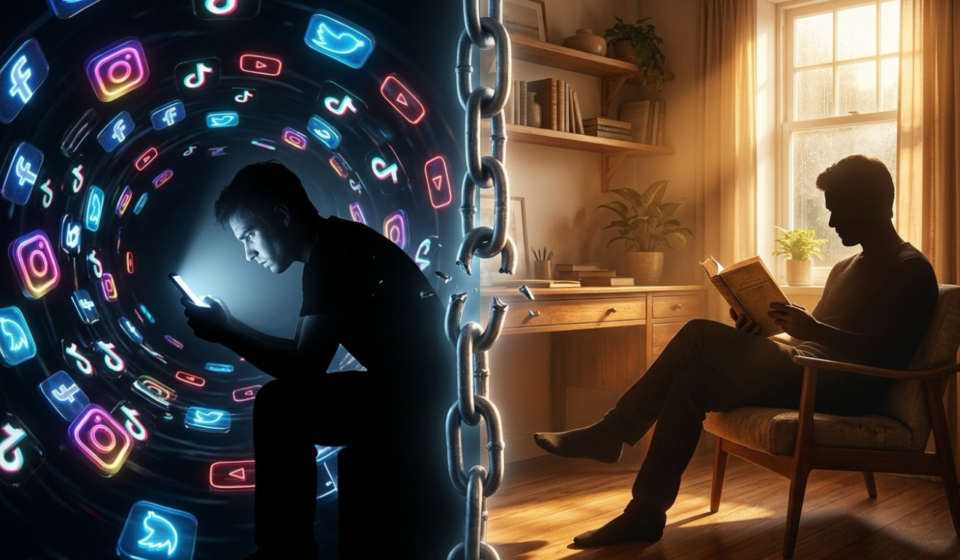

It’s 2:47 AM. You told yourself you’d go to bed an hour ago. But here you are — thumb moving, eyes burning, brain full of static. You’re not even enjoying it. You’re just… scrolling.
If this sounds familiar, you’re not alone. And more importantly: it’s not your fault. If you’re wondering how to fight phone addiction, this guide is for you.
Your phone was designed by some of the smartest engineers in the world to keep you scrolling. The infinite scroll, the pull-to-refresh, the notification badges — every element is a deliberate choice to capture and hold your attention.
But here’s the good news: the same science that makes these apps addictive can be used to break the addiction. This guide will show you exactly how to fight phone addiction — not with willpower, but with neuroscience, environment design, and strategy.
Chapter 1: The Neuroscience of Phone Addiction
The Dopamine Loop
Dopamine is not the “pleasure chemical.” It is the “anticipation chemical.” Your brain releases dopamine not when you receive a reward, but when you expect one.
This is why slot machines are so addictive. You don’t know when you’ll win. The uncertainty keeps you pulling the lever.
Social media works the same way. Every time you open an app, you’re pulling a lever. Sometimes you see something boring. Sometimes you see something interesting. And sometimes — just often enough to keep you hooked — you see something that makes you laugh, or you get a like, or someone leaves a comment.
This is called variable ratio reinforcement, and it is the most powerful schedule of reinforcement known to behavioral psychology. It is the same principle that makes gambling addictive, and it is deliberately built into every major social media platform.
Sean Parker, the founding president of Facebook, publicly admitted that the platform was built to exploit “a vulnerability in human psychology.” Tristan Harris, a former Google design ethicist, has compared social media to slot machines. The comparison is not hyperbolic — it is precise.
The Infinite Scroll
In the early days of the internet, websites had pages. You would read to the bottom, click “next,” and wait for a new page to load. This natural stopping point gave your brain a moment to decide: Do I want to continue?
Then came the infinite scroll. Now, there is no bottom. There is no “next page.” There is no natural stopping point. You can scroll forever, and your brain never gets a signal to stop.
This was not an accident. It was a deliberate design choice to maximize “time on site” — a metric that directly translates to advertising revenue.
The Comparison Trap
Social media is not just about entertainment. It is about social comparison. Every time you see someone’s vacation, promotion, or perfect relationship, your brain compares it to your own life. And you always lose.
This triggers the release of cortisol, the stress hormone. Over time, chronic cortisol elevation leads to anxiety, depression, and insomnia.
A 2018 study published in the Journal of Social and Clinical Psychology found that limiting social media use to 30 minutes per day led to significant reductions in loneliness and depression. The control group, which used social media normally, showed no improvement. The conclusion was clear: less social media means better mental health.
The Attention Span Crisis
In 2000, the average human attention span was 12 seconds. By 2015, it had dropped to 8 seconds. Goldfish, for the record, have an attention span of 9 seconds.
This is not a coincidence. It is the result of years of context-switching, notification-checking, and rapid-fire content consumption. Your brain has been trained to expect novelty every few seconds. When it doesn’t get it, it feels bored and restless.
The good news? This is reversible. The brain is plastic. It can heal.
Chapter 2: Why You Can’t Stop (And Why It’s Not Weakness)
Willpower Is a Finite Resource
You can only resist temptation for so long. If you rely on willpower to stop scrolling, you will eventually fail. You will have a bad day, or you will be bored, or you will be stressed — and you will reach for your phone.
The solution is not more willpower. The solution is environment design. By changing your environment, you add friction between you and the scroll. You make the habit harder to execute. And when the habit becomes harder, it becomes weaker.
The “Phantom Vibration” Phenomenon
Have you ever felt your phone buzz in your pocket, only to pull it out and find no notification?
This is called “phantom vibration syndrome,” and it affects up to 73% of adults. It is a sign that your brain has been conditioned to expect constant stimulation. Your nervous system is on high alert, waiting for the next dopamine hit.
The good news: this fades within a week of reducing phone use.
Chapter 3: How to Fight Phone Addiction — The Complete Strategy
Strategy 1: Add Friction
The easier something is to do, the more likely you are to do it. So make the scroll harder to start.
Delete the apps. Not just log out. Delete them. This is one of the most effective ways to fight phone addiction.
Log out after every use. If you must use social media on a browser, log out each time. This adds friction.
Remove saved passwords. Force yourself to type in your password every time. This adds another layer of friction.
Move apps off your home screen. Put them in a folder on the last page. That extra swipe is enough to break the automatic habit.
Strategy 2: Reduce Triggers
Grayscale mode. Turn your phone screen to grayscale. Another powerful method to fight phone addiction is removing color triggers..
Turn off all non-human notifications. Your phone should only buzz when a real person is trying to reach you. Not when an app wants your attention.
Turn off notification badges. Those little red numbers are designed to create anxiety. Turn them off.
Strategy 3: Change Your Environment
Charge your phone outside the bedroom. Buy an alarm clock. Charge your phone in the kitchen. This breaks the habit of picking up the phone first thing in the morning and last thing at night.
Create a “phone-free” zone. Designate one room (or one chair) as a phone-free zone. This could be the dining table, the couch, or the bedroom.
Keep a book where you used to keep your phone. Replace the habit. When you reach for your phone, you’ll find a book instead.
Strategy 4: Use Phone Settings
Your phone has built-in features designed to stop doomscrolling. Most people never use them.
App Timers: Set a daily limit for each app. When you hit the limit, the app grays out. You can override it — but the pause makes you think.
Downtime Mode: Restrict your phone to calls and essential apps during specific hours (e.g., 10 PM to 7 AM). When you can’t open the app, you can’t scroll.
Focus Mode: Block distracting apps and notifications while you work. Deep work requires sustained attention. Focus Mode prevents interruptions before they happen.
Screen Time Reports: Check your usage weekly. Awareness is the first step to change.
Strategy 5: Replace the Void
When you remove the scroll, you create a void. If you don’t fill it with something meaningful, you will relapse.
Ideas:
- Read a physical book
- Learn a new skill (language, instrument, coding)
- Exercise
- Cook a real meal
- Call a friend (actually call, don’t text)
- Go for a walk without headphones
- Write in a journal
- Meditate
The goal is not to be productive every second. The goal is to be present. To experience life without the filter of a screen.
A day-by-day plan that sequences friction, cue removal, and habit replacement — so you’re not redesigning your phone habits from scratch. 60-day guarantee.
See the Full System →Chapter 4: The Best Apps to Fight Phone Addiction
If phone settings aren’t enough, these apps add additional layers of friction.
1. One Sec
One Sec forces you to take a deep breath before opening a distracting app. It adds a 5-second delay. That delay is often enough to break the automatic loop.
2. ScreenZen
ScreenZen adds a pause before opening apps. You can set it to ask “Do you really need to open this?” before allowing access. It’s free and works on both iPhone and Android.
3. Opal
Opal blocks distracting apps and tracks your screen time. It uses “focus scores” to gamify your progress.
4. Freedom
Freedom blocks apps and websites across all your devices. You can schedule blocks in advance.
5. Forest
Forest gamifies focus. You plant a virtual tree when you start a focus session. If you leave the app, the tree dies.
The Problem with Apps: Apps alone don’t work. You can always delete them or override them. The key is to combine apps with phone settings and environment design. Layered defenses are stronger than any single solution.
Chapter 5: How to Fight Phone Addiction at Night
Nighttime doomscrolling is the most common and most damaging. It destroys sleep, increases anxiety, and creates a cycle of fatigue.
The Digital Sunset Protocol
One hour before bed, all screens go off. No TV, no tablet, no phone. This includes reading on a Kindle or iPad.
The blue light emitted by screens suppresses melatonin, the hormone that signals to your brain that it’s time to sleep. Even a small amount of blue light can delay sleep onset by up to 90 minutes.
Replace screen time with analog activities:
- Reading a physical book
- Gentle stretching
- Journaling
- Listening to calm music
- Taking a warm bath
Temperature Therapy
A hot shower or bath about 90 minutes before bed is a powerful sleep aid. When you get out of the hot water, your body temperature drops. This rapid cooling signals the brain to produce melatonin.
This is not anecdotal. It is physiology. Your core body temperature needs to drop by about 1°C to initiate sleep. A hot bath accelerates this process.
The Brain Dump Journal
Anxiety keeps you awake. If your mind is racing with thoughts of what you need to do tomorrow, you will not sleep.
Keep a notepad on your nightstand. If you think of something you need to do, write it down. This tells your brain, “You don’t need to keep this in working memory; it’s written down.” This frees the mind to sleep.
The 4-7-8 Breathing Technique
When you find yourself tossing and turning, try the 4-7-8 method:
- Inhale for 4 seconds
- Hold for 7 seconds
- Exhale for 8 seconds
Repeat four times.
This activates the parasympathetic nervous system, lowering heart rate and blood pressure. It is a physiological switch that forces the body into a state of calm.
The Cognitive Shuffle
This technique was developed by Dr. Luc Beaudoin, a cognitive scientist at Simon Fraser University. It’s one of the most effective ways to shut down a racing mind.
Here’s how it works: Pick a random word with at least six letters. Let’s use “BEDTIME.” For each letter, visualize as many items as you can that start with that letter.
- B: Banana, Balloon, Bottle, Bear, Bridge
- E: Elephant, Egg, Envelope, Engine
- D: Dog, Door, Diamond, Drum
This technique scrambles your visual thoughts and mimics the random firing of neurons that occurs naturally before sleep. It prevents your brain from engaging in the kind of linear, logical thinking that keeps you awake.
Chapter 6: What Happens When You Finally Fight Back
Week 1: Withdrawal
The first three days are the hardest. Your brain, deprived of its usual dopamine hits, will protest.
Common symptoms:
- Anxiety: A low-level hum of unease that you can’t shake.
- Phantom vibration syndrome: Feeling your phone buzz when it hasn’t.
- Irritability: Snapping at people for no reason.
- Insomnia: Ironically, sleep often gets worse before it gets better.
This is not a sign that something is wrong. It is a sign that something is working. Your brain is recalibrating. The discomfort is temporary.
Week 2: The Fog Lifts
By the second week, the acute anxiety begins to subside. You start to experience something you haven’t felt in years: genuine boredom.
For a digital native, boredom feels almost painful. But boredom is the birthplace of creativity. When you stop consuming content, your brain starts generating it.
Sleep improvement: By day 10, most people report significant improvements in sleep quality. Without blue light exposure at night and without cortisol spikes from doom-scrolling, the body remembers how to sleep.
Week 3: Deep Focus Returns
By the third week, attention span begins to restore. Tasks that felt impossible — reading a book, writing a report, having a long conversation — become easier.
This is due to neuroplasticity. By not constantly switching tasks, your brain is relearning how to stay on a single track. You are effectively undoing the damage of the “Goldfish Effect.”
Week 4: Emotional Stability
By the fourth week, mood stabilizes. The highs aren’t as high (no viral post dopamine hits), but the lows aren’t as low. You are no longer riding the emotional rollercoaster of likes and comments.
Self-worth: Without the metrics of social media, self-worth becomes intrinsic rather than extrinsic. You are not valuable because 100 people liked your photo. You are valuable because you are productive, kind, and present.
Chapter 7: The 30-Day Plan That Actually Works
If you’ve read this far, you already know the problem. The most effective system for how to fight phone addiction is one built by a former Silicon Valley UX designer..
The most effective system I’ve found for fighting phone addiction is one built by a former Silicon Valley UX designer who actually created addictive apps. He knows the enemy because he was the enemy. And he’s turned those same psychological principles into a 30-day protocol that works without willpower.
The system includes:
- A 30-Day Daily Protocol — Progressive tasks that build momentum
- App-by-App Elimination Strategy — Instagram, TikTok, Twitter, news apps
- Focus Recovery Techniques — Rebuild your attention span
- Notification Optimization System — Configure devices to serve you
- Replacement Activity Framework — Fill the void with meaningful activities
- Relapse Prevention Protocols — Long-term immunity
For a complete overview of this system, read my full guide: Digital Declutter: The 30-Day Plan to Break Phone Addiction and Reclaim Your Life.
Chapter 8: Real Results — What Happens When You Fight Back
Thousands of people have successfully learned how to fight phone addiction and transformed their lives. Here are some of their stories:
“I was spending 8+ hours on my phone daily. Within the first week I was under 2 hours. I’ve finished two major projects that were collecting dust. This literally gave me my life back.”
— Sarah M., Marketing Director, Seattle
“I was failing my classes because I couldn’t study without checking Instagram every 5 minutes. My GPA went from 2.3 to 3.7 in one semester. My parents are amazed.”
— Jake T., Student, Univ. of Michigan
“I scrolled until 2am every night. The sleep protocols changed everything — I now sleep 7-8 hours without my phone in the bedroom. My anxiety dropped dramatically.”
— Lisa K., Teacher, Denver
These are not outliers. These are normal people who learned how to fight phone addiction using proven strategies.
Instead of resisting the urge every time it hits, a structured system targets the cue and reward stages directly — so there’s less to resist in the first place.
Frequently Asked Questions
Is phone addiction real? Yes. Phone addiction is recognized as a behavioral addiction. The devices are designed to be addictive, using the same dopamine loops as slot machines.
How do I fight phone addiction? Start by removing willpower from the equation. Focus on environment design: charge your phone outside the bedroom, turn off notifications, use grayscale mode, and set app timers.
What is doomscrolling? Doomscrolling is the compulsive consumption of negative or endless content. The term gained popularity during the COVID-19 pandemic, but it applies to any endless scroll.
How do I stop doomscrolling at night? Set Downtime Mode for 10 PM to 7 AM. Charge your phone outside the bedroom. Get a separate alarm clock. Use the Digital Sunset protocol — no screens one hour before bed.
Can phone addiction be reversed? Yes. Neuroplasticity means the brain can heal. Most people experience significant improvement within 2-3 weeks, including better sleep, focus, and mood.
Do I need to delete all my apps? No. The strategies in this guide — app timers, downtime, grayscale, environment design — can dramatically reduce scrolling without deleting anything. Deletion is the nuclear option.
What is the fastest way to fight phone addiction? The fastest way to fight phone addiction is to add friction — delete apps, charge outside bedroom, and set Downtime Mode.
Can I fight phone addiction without deleting apps? Yes, you can fight phone addiction without deleting anything. Use app timers, grayscale, and environment design.
Conclusion: Fight Back Today
You don’t need willpower. You need a system. Learning how to fight phone addiction is not about deprivation. It’s about liberation..
Your phone was designed to be addictive. But the same science can be used against it. App timers. Downtime. Grayscale. Environment design. Replacement activities.
Start with two changes today:
- Charge your phone outside the bedroom
- Set Downtime Mode for bedtime
Use these for one week. Then add Grayscale, App Timers, and Home Screen Friction.
Your brain will thank you.
For a complete 30-day system that uses these strategies plus environment design, habit stacking, and relapse prevention, read my full guide: Digital Declutter: The 30-Day Plan to Break Phone Addiction and Reclaim Your Life (Insert internal link here).
Disclaimer: This information is for educational purposes only and is not intended as medical or therapeutic advice. Individual results may vary.