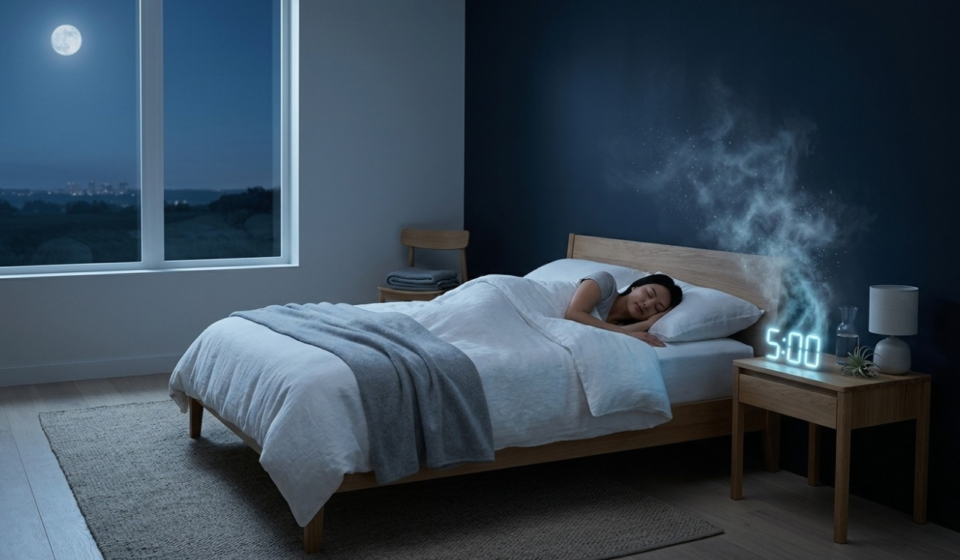

You are lying in bed. The room is dark. The temperature is perfect. Your body is heavy with exhaustion, screaming for rest. But your brain? Your brain has decided it is the perfect time to replay that awkward conversation from 2014, plan a grocery list for next month, and worry about a deadline that isn’t even until Friday.
If this sounds familiar, you are not alone. The inability to shut off your thoughts is the number one reason people struggle to drift off. It is a frustrating cycle: the harder you try to sleep, the more awake you become.
You have likely tried the standard advice. “Just relax.” “Count sheep.” “Put your phone down.” While these are valid, they often fail when your mind is in a state of hyper-arousal.
What you need is not a lifestyle change that takes weeks to master. You need an emergency brake for your brain. You need a way to force your cognitive processes to stop spinning so your physiological systems can take over.
Today, we are going to explore one of the most effective hacks to fall asleep that exists: The 5-Minute Mind Wipe. This isn’t just about relaxation; it is about actively clearing the mental cache so your brain can enter the maintenance mode we call sleep.
Table of Contents
Why Your Brain Won’t Shut Off
Before we get to the solution, we have to understand the enemy. Why does your brain betray you at night?
During the day, your brain is bombarded with stimuli. Emails, conversations, decisions, traffic, noise. To function, your brain utilizes a filter called the Reticular Activating System (RAS). It keeps you focused on the task at hand.
When you finally lie down in a quiet room, the external stimuli vanish. The brain, suddenly deprived of input, turns its attention inward. It starts processing the backlog of the day. It looks for unresolved issues. It scans for threats.
This is known as the “Default Mode Network” (DMN). When the DMN kicks in, your brain is essentially cleaning house. The problem is, it doesn’t know when to stop. It creates a loop of rumination.
This is where most insomnia hacks fail. They try to distract the brain with sounds or white noise. While helpful, they don’t address the root cause: the brain is actively engaged in problem-solving mode. To sleep, we need to force a system shutdown.
Understanding why your brain won’t shut off is the first step in finding the right hacks to fall asleep that actually work for your unique situation.
Read More:Why Can’t I Sleep Even When Tired? 8 Real Reasons (2026)
The Science of the “Mind Wipe”
The “Mind Wipe” is a cognitive technique that combines elements of mindfulness, sensory deprivation, and visualization. It relies on a concept called “Cognitive Shuffling.”
Cognitive Shuffling was popularized by Dr. Luc Beaudoin, a cognitive scientist. The theory is simple: the brain cannot easily process random, nonsensical information. If you force your brain to focus on random, unrelated items, it cannot maintain the anxiety loop. It gets bored, and when the brain gets bored, it falls asleep.
The “Mind Wipe” takes this a step further. It isn’t just about random words; it is about the visual and sensory eviction of thoughts. By visualizing a “wipe,” you are giving your brain a command to clear the slate.
Many people searching for hacks to fall asleep overlook the power of cognitive shuffling. They focus on pillows, mattresses, and supplements. While those matter, the brain is the command center. If the command center is noisy, the body cannot rest. This technique is one of the most potent hacks to fall asleep because it works directly on the source of the problem: the overactive mind.
A structured 5-step protocol built around the actual physiology behind hyperarousal — not generic “relax more” advice.
The 5-Minute Mind Wipe Protocol
This technique takes exactly five minutes. It requires no apps, no gadgets, and no special equipment. It only requires your focus.
Phase 1: The Purge (Minutes 1-2)
You cannot wipe a whiteboard that is covered in permanent marker. First, you must acknowledge the thoughts.
- The Scan: Close your eyes. Do a quick mental scan of your body. Notice the tension in your jaw, your shoulders, and your legs. Clench your fists tightly for five seconds, then release. Do the same with your toes. This grounds you in the physical.
- The “Parking Lot”: Imagine a parking lot in your mind. Every thought that pops up—”I need to buy milk,” “Did I send that email?”—must be parked in a specific spot. Visualize the thought as a car. Park it. Say to yourself, “I will deal with that at 9 AM.” You are not suppressing the thought; you are scheduling it. This signals to the brain that it is safe to let go.
Phase 2: The Wipe (Minutes 3-5)
Now, the actual wipe. This is where the magic happens. You are going to overload your visual cortex to shut down the verbal cortex.
- The Image: Visualize a chalkboard, a whiteboard, or a foggy mirror. It represents your mind.
- The Action: Imagine a giant eraser or a squeegee. Slowly, from left to right, wipe the board. As you wipe, imagine the thoughts from the day dissolving into dust.
- The Randomization: This is the key. As the board becomes clean, your brain will try to write new thoughts on it. You must immediately overwrite them with random, unrelated images.
- Example: A purple cow wearing a top hat. A skateboard made of jelly. A cloud shaped like a toaster.
- The Rhythm: Do not visualize a story. Visualize random snapshots. If you visualize a story, your brain engages logic. If you visualize random images, your brain gets confused and disengages.
The “A-Z” Variation (If the Wipe Fails):
If the visual wipe isn’t working, try the cognitive shuffle. Pick a letter, say “A.” Think of a word starting with A (Apple). Visualize it for 2 seconds. Then go to “B” (Boat). Visualize it. Do not connect them. Just random items. This is one of the most effective hacks to fall asleep because it mimics the random firing of neurons that occurs during the onset of sleep.
Why This Works When Other Hacks Fail
Most sleep aids try to relax you. The “Mind Wipe” distracts you.
If you are anxious about sleeping, relaxation is difficult. You are trying to relax, which is a task. The Mind Wipe gives you a different task. It occupies the “computing power” of your brain with nonsense.
Think of your brain as a browser with 50 tabs open. You can’t sleep because the tabs are running in the background. The Mind Wipe is the “Force Quit” button.
Furthermore, this technique engages the visual-spatial part of your brain. When you are visualizing images, you are not verbalizing worries. You cannot think in words and pictures at the same time effectively. By forcing the brain into “picture mode,” you disable the “word mode” where anxiety lives.
There are hundreds of hacks to fall asleep circulating on the internet. Some involve breathing patterns. Some involve weird food combinations. Some involve tapping. But the Mind Wipe is unique because it requires zero preparation. You can do it anywhere, anytime. It is a portable, free, and highly effective tool in your sleep arsenal.
The Role of “Sleep Hygiene” (The Tease)
While the Mind Wipe is a powerful tool, it is important to remember that it is a “rescue” technique. It is what you do when you are already in bed and struggling.
However, if you find that you are relying on the Mind Wipe every single night, there is likely an underlying issue that needs to be addressed. The Mind Wipe clears the fog, but it doesn’t fix the engine.
There are deeper physiological and environmental factors that dictate whether your brain is capable of shutting off. For example, if your cortisol levels are spiked due to a specific timing issue in your daily routine, or if your body temperature isn’t dropping correctly, no amount of mental wiping will work.
Many people master the Mind Wipe but still wake up at 3 AM. This is usually not a brain problem, but a blood sugar or hormonal problem. This is why relying solely on hacks to fall asleep that target the mind is only half the battle. You must also address the body.
Common Mistakes to Avoid
When trying to implement these insomnia hacks, people often make a few critical errors.
1. Trying Too Hard:
The Mind Wipe is a passive exercise. If you are “trying” to wipe the board, you are creating tension. You must let the images flow. If a thought interrupts, don’t get angry. Just gently wipe it away and return to the random images.
2. Checking the Clock:
Do not open your eyes to check the time. Every time you look at the clock, you are calculating how much sleep you will get. This triggers math anxiety, which triggers adrenaline. Keep your eyes closed.
3. The “White Knuckle” Effect:
If you are physically tense, your brain will remain tense. Do a quick progressive muscle relaxation before starting the wipe. If your body is rigid, your mind will follow.
4. Inconsistent Sleep Schedule:
The Mind Wipe can put you to sleep, but if you wake up at different times every day, you are giving yourself jet lag. Your brain needs a consistent anchor point.
5. Expecting Miracles on Night One:
Like any skill, the Mind Wipe takes practice. The first night, you might still be awake after 5 minutes. That’s okay. The goal is to reduce the mental noise. Even if you don’t fall asleep immediately, the reduction in anxiety is a win.
The “Secret Sauce” to Deep Sleep
We have discussed the mental aspect of sleep. We have given you a technique to clear your mind. But there is a missing piece of the puzzle.
Why do some people fall asleep in 2 minutes while others fight for hours?
The answer often lies in the “Sleep Switch.” There are specific biological triggers that signal the brain to release melatonin and shut down. The Mind Wipe handles the psychological noise, but it doesn’t necessarily flip the biological switch.
If you are doing the Mind Wipe and it works 50% of the time, but fails the other 50%, it means your biological trigger is broken.
To get a complete solution, you need to understand how to prepare your body chemistry before you even hit the pillow. There is a specific “pre-sleep” routine that, when combined with the Mind Wipe, can turn a 2-hour struggle into a 5-minute process.
Most hacks to fall asleep only address one variable. They either target the mind OR the body. The true secret is in the synergy between the two. When you combine the mental clarity of the Mind Wipe with the biological priming of a specific evening routine, you create an environment where sleep is not just possible, but inevitable.
Summary Checklist for Tonight
If you are ready to try this tonight, here is your checklist:
- Dim the Lights: 1 hour before bed.
- Cool the Room: 65-68 degrees Fahrenheit (18-20 Celsius).
- The Purge: When your head hits the pillow, park your thoughts.
- The Wipe: Visualize the board. Randomize the images.
- The Reset: If you are still awake after 20 minutes, get out of bed. Do not toss and turn.
Conclusion
Sleep is not a switch you flip; it is a process you enter. The “5-Minute Mind Wipe” is your key to the door. It stops the chattering monkey mind and allows your body to take over.
Try it tonight. Close your eyes. See the board. Wipe it clean. And if you find that your brain is still fighting you, it might be time to look deeper at the biological root cause. The Mind Wipe clears the mental clutter, but ensuring your body is primed for sleep is the final piece of the puzzle.
There are countless hacks to fall asleep available, but few are as immediate and accessible as this one. You have the tool. Now, you just need to use it. Sweet dreams.
A written protocol that turns evidence-based techniques into a night-by-night plan — instead of trying to remember all 12 from scratch. 60-day guarantee.
See the Full System →