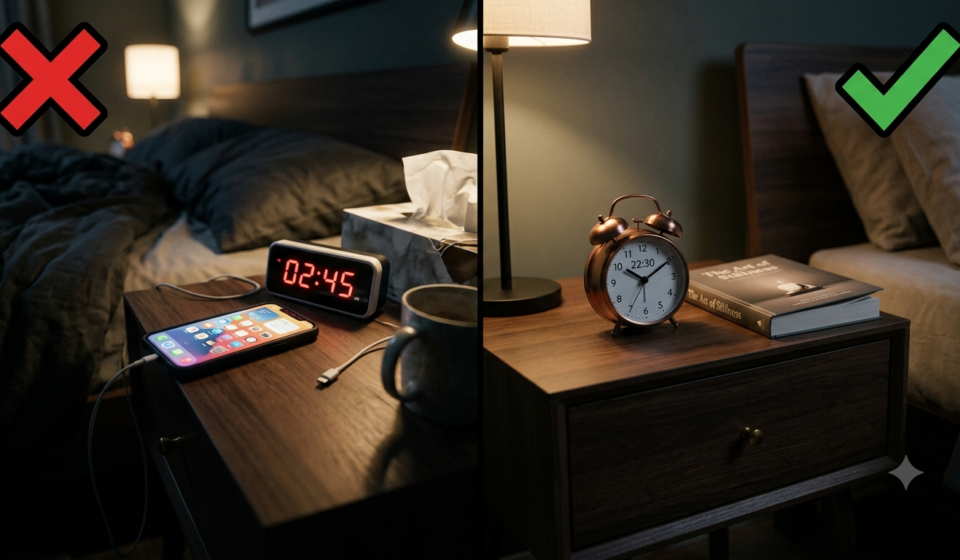

How to break phone addiction without willpower comes down to one idea: change your environment, not your self-control — here’s exactly how.
Disclosure: This article contains affiliate links. If you buy through them, we may earn a commission at no extra cost to you. See our full Affiliate Disclosure. This is not medical advice — see our Disclaimer.
If you’ve searched for how to break phone addiction without willpower, you’ve probably already tried the willpower approach — and it probably didn’t stick. That’s not a personal failing. It’s a mismatch between the tool (willpower, which is limited and fatigues throughout the day) and the problem (an environment and set of interfaces specifically engineered to capture attention automatically, without requiring your conscious decision at all). This article covers why the willpower approach tends to fail, and what actually works based on habit science and behavioral design instead.
A day-by-day plan that sequences friction, cue removal, and habit replacement — so you’re not redesigning your phone habits from scratch. 60-day guarantee.
See the Full System →Why Willpower Isn’t the Right Tool for This Problem
Most advice about phone use assumes the solution is deciding to use your phone less and then following through on that decision. The problem is that modern apps are built by teams specifically optimizing for engagement — variable reward schedules (the same psychological mechanism behind slot machines), infinite scroll (removing the natural stopping point your brain used to get from reaching “the end” of something), and notification design tuned to interrupt you at the moments most likely to pull your attention.
This is genuinely how to break phone addiction without willpower as a starting principle: you’re not fighting a bad habit in the way you might fight the urge to skip a workout. You’re up against a system deliberately engineered by people whose job is to make disengaging harder than engaging. Trying to out-willpower a system built by specialists to defeat exactly that is a losing structural position — which is why so many people who genuinely want to use their phone less still struggle, despite real effort.
Read More: Natural Insomnia Remedies That Actually Work: 12 Evidence-Based Options (2026)
The Real Mechanism: Cue, Routine, Reward
Habit science describes most automatic behaviors — phone checking very much included — through a three-part loop: a cue (boredom, a notification sound, an awkward silence, even just picking up your phone from habit), a routine (unlocking, opening an app), and a reward (novelty, social validation, distraction from discomfort). The loop repeats and strengthens with each cycle, largely below conscious awareness.
Understanding this matters because it reframes the entire question of how to break phone addiction without willpower: instead of trying to resist the routine step through conscious effort every single time a cue appears (which is exhausting and fails under stress, fatigue, or a busy day), the more sustainable approach is intervening at the cue and reward stages — making the cues less frequent or less available, and either removing or redesigning the reward.
Instead of resisting the urge every time it hits, a structured system targets the cue and reward stages directly — so there’s less to resist in the first place.
Practical Techniques That Don’t Rely on Willpower
1. Increase Friction on the Apps You Overuse
One of the most effective, well-supported techniques for how to break phone addiction without willpower is deliberately making problem apps slightly harder to access — not impossible, just inconvenient enough to interrupt the automatic loop. Removing apps from your home screen (requiring a search to open them), logging out after each use so you have to re-enter credentials, or using built-in screen time tools to add a delay before opening specific apps all work on the same principle: friction disrupts automaticity without requiring a moment-by-moment willpower decision.
2. Remove the Cue, Not Just the Behavior
If notifications are a major cue, turning off non-essential notifications (nearly everything except messages from actual people, not apps) removes hundreds of daily prompts before they ever reach you — which is a fundamentally different, and more sustainable, strategy than trying to ignore each notification individually as it appears. This is a core piece of how to break phone addiction without willpower, because it addresses the trigger itself rather than asking you to resist it every time.
Read More: ProDentim Reviews and Complaints 2026 — What Other Articles Are Not Telling You
3. Design Phone-Free Physical Zones
Keeping your phone out of the bedroom, off the dinner table, or out of reach during focused work removes the cue of visual and physical proximity — research on “attention residue” and even the mere presence of a phone (even face-down, even powered off) has shown measurable effects on cognitive performance in some studies, simply because part of your attention is unconsciously monitoring for it.
4. Use Grayscale Mode
Switching your screen to grayscale removes much of the color-driven visual reward that makes apps like Instagram and TikTok engaging at a sensory level — icons, photos, and video all become less immediately stimulating. This is a low-effort environmental change rather than a willpower-based one, and several informal and small-scale studies have found it reduces phone checking frequency without any conscious resistance required.
5. Replace, Don’t Just Remove
A behavior that’s simply removed tends to leave a gap the brain wants to fill with something. Having a specific, ready alternative for the same cue — a short walk, a physical book kept visible near your phone charger, a specific playlist — gives the cue-routine-reward loop somewhere else to go, which tends to be more sustainable than trying to create a void and rely on discipline to keep it empty.
6. Implementation Intentions
This is a well-studied behavior-change technique: instead of a vague goal (“use my phone less”), a specific if-then plan (“if I feel the urge to check my phone during a work task, then I will look out the window for 60 seconds first”) has consistently shown better follow-through than intention alone in behavioral research. It works because it removes the in-the-moment decision-making that willpower depends on — the plan is already made.
7. Habit Stacking
Attaching a new, desired behavior to an existing, already-automatic one (charging your phone in the kitchen rather than the bedroom as part of your existing bedtime routine, for instance) uses your brain’s existing automaticity rather than fighting it, which is a more efficient path to change than building an entirely new habit from a conscious decision every night.
8. Batch Notifications and Checking Times
Rather than checking messages and apps continuously throughout the day (each check re-triggering the reward loop and making the next check more likely), designating a few specific windows for checking — say, three set times rather than constant availability — reduces the total number of cue-routine-reward cycles per day without requiring resistance during the gaps between them.
Why “Just Delete the App” Often Doesn’t Work Alone
A common first instinct is deleting problem apps entirely, and for some people this works well. For others, it doesn’t hold — because the underlying cue (boredom, a stressful moment, social habit) is still present, and without a replacement or friction-based strategy, the behavior often just shifts to another app or to reinstalling the deleted one within days. This is part of why a more complete approach to how to break phone addiction without willpower usually combines several of the techniques above — friction, cue removal, and replacement together — rather than relying on a single tactic in isolation.
Addressing the Root Anxiety, Not Just the Behavior
For many people, phone checking is tied to a specific anxiety — fear of missing something important, social FOMO, or using the phone as a coping mechanism for boredom or discomfort. Addressing that underlying discomfort directly (even briefly — noticing “I’m reaching for my phone because I feel uncomfortable right now, not because I actually need to check anything”) tends to produce more durable change than addressing only the physical behavior, since the behavior itself is often a symptom of the discomfort rather than the root cause.
What a Structured Program Adds
Applying eight different techniques simultaneously, from scratch, while already in the habit loop you’re trying to break, is a lot to hold in your head consistently — which is where a structured, day-by-day program has a real advantage over trying to implement all of this from a single article. A program built around a 30-day sequence (introducing changes progressively — starting with lower-friction ones like notification changes before moving to habit replacement and relapse-prevention planning later) tends to be easier to actually follow through on than trying to apply everything at once. This is the structural role something like the Digital Declutter program plays: less about a single new technique, and more about sequencing the techniques above into a day-by-day protocol so you’re not trying to redesign your entire relationship with your phone in one sitting. It’s a one-time purchase with a 60-day guarantee, so there’s a real window to test whether the structured version works better for you than piecing it together yourself.
Frequently Asked Questions
Why does willpower-based phone reduction usually fail after a few days? Willpower is a limited, fatiguing resource that depletes over the course of a day, especially under stress — while the apps you’re trying to resist are specifically engineered to be easiest to fall back into exactly when your resistance is lowest (boredom, fatigue, stress). Environmental and habit-based changes don’t depend on your resistance level in the same way.
Is deleting social media apps enough on its own? For some people, yes. For others, the underlying cue and reward-seeking behavior simply redirects to another app or leads to reinstalling within days. Combining app removal with friction, cue reduction, and a replacement behavior tends to be more durable than deletion alone.
How long does it take to notice reduced phone-checking urges? Individual results vary, but habit-change research generally shows initial reductions in automatic checking within the first 1–2 weeks of consistent friction and cue changes, with more complete shifts over 3–4 weeks as new patterns become the new automatic default.
Does grayscale mode actually make a difference? Several informal and small-scale studies suggest it reduces checking frequency by reducing the sensory reward of colorful interfaces, though it’s most effective combined with other changes (notifications, friction) rather than as a standalone fix.
Can this approach work for someone who needs their phone for work? Yes — the goal isn’t eliminating phone use, it’s reducing automatic, reward-driven checking specifically. Notification batching and app-specific friction can be applied selectively, leaving work-essential functions like calls and specific messaging apps fully accessible.
The Bottom Line
How to break phone addiction without willpower ultimately comes down to changing your environment and your habit loops rather than trying to out-resist an interface engineered by specialists to be resisted. Friction on problem apps, removing unnecessary notification cues, phone-free physical zones, and having a ready replacement behavior address the actual mechanism — cue, routine, reward — instead of asking you to win a daily battle of self-control against a system built to win that battle. If you’ve tried willpower-based approaches before and they didn’t stick, that’s not evidence the goal is unreachable — it’s evidence the tool didn’t match the problem, and a structured, sequenced approach that changes the environment first tends to succeed where forcing discipline alone hasn’t.
This article is for informational purposes and reflects general behavioral-science research. It is not medical or therapeutic advice. Consult a healthcare provider before beginning any new program, particularly if an existing mental health condition is involved.
(how to break phone addiction without willpower, how to break phone addiction without willpower, how to break phone addiction without willpower, how to break phone addiction without willpower, how to break phone addiction without willpower, how to break phone addiction without willpower, how to break phone addiction without willpower, how to break phone addiction without willpower, how to break phone addiction without willpower, how to break phone addiction without willpower ,how to break phone addiction without willpower, how to break phone addiction without willpower, how to break phone addiction without willpower, how to break phone addiction without willpower, how to break phone addiction without willpower)