
Why can’t I sleep even when tired? It’s usually not about tiredness at all — here are 8 real reasons this happens and what actually helps.
Disclosure: This article contains affiliate links. If you buy through them, we may earn a commission at no extra cost to you. See our full Affiliate Disclosure. This is not medical advice — see our Disclaimer.
Why can’t I sleep even when tired? It’s one of the most common and most confusing sleep complaints there is — you spend all day exhausted, counting down to bedtime, and then the moment your head hits the pillow, you’re wide awake. This isn’t a contradiction or a character flaw. Tiredness and sleepiness are actually two different physiological states, and understanding the difference is the first step to figuring out why can’t I sleep even when tired keeps happening night after night.
This article covers eight real, evidence-based reasons this happens, and what actually helps with each one.
A written protocol that walks you through fixing hyperarousal, circadian misalignment, and racing thoughts step by step. 60-day guarantee.
See the Full System →Tired vs. Sleepy: Why They’re Not the Same Thing
Before the specific reasons, this distinction matters more than almost anything else on this list. Tiredness (fatigue) is a subjective sense of low energy and exhaustion. Sleepiness is a distinct physiological drive to fall asleep, driven mainly by two systems: your circadian rhythm (your internal clock) and sleep pressure (adenosine buildup from time spent awake). You can be deeply tired without being physiologically sleepy — which is exactly the trap behind why can’t I sleep even when tired, and it’s why “just go to bed earlier” often doesn’t work as advice: if your sleepiness systems aren’t aligned with your bedtime, earlier just means more time lying awake.
1. Hyperarousal (Your Nervous System Is Stuck “On”)
This is one of the most common answers to why can’t I sleep even when tired, and it’s a genuine physiological state, not a mindset problem. Chronic stress keeps your sympathetic nervous system — the “fight or flight” system — more active than it should be at bedtime, alongside elevated cortisol at a time it should be dropping. The result is a body that’s exhausted but a nervous system that’s still activated, which produces exactly the wired-but-tired feeling most people describe.
Read More: Natural Insomnia Remedies That Actually Work: 12 Evidence-Based Options (2026)
2. A Misaligned Circadian Rhythm
If your internal clock is shifted relative to your desired bedtime — from irregular sleep schedules, shift work, travel, or inconsistent light exposure — your body may simply not be physiologically ready for sleep at the time you’re trying to force it. This is a frequently overlooked answer to why can’t I sleep even when tired, especially for people who sleep in significantly on weekends, since that alone can shift your internal clock by an hour or more by Sunday night.
3. Too Much Sleep Pressure Released Too Early
Sleep pressure — the buildup of adenosine that makes you feel sleepy the longer you’re awake — builds throughout the day and is supposed to peak at bedtime. A long nap late in the afternoon, even an unintentional 20-minute doze on the couch, can release enough of that pressure that by bedtime, your body doesn’t have enough of the physiological “push” left to fall asleep easily, even though you still feel generally tired.
A structured 5-step protocol built around the actual physiology behind hyperarousal — not generic “relax more” advice.
4. Screen Light and Content Right Before Bed
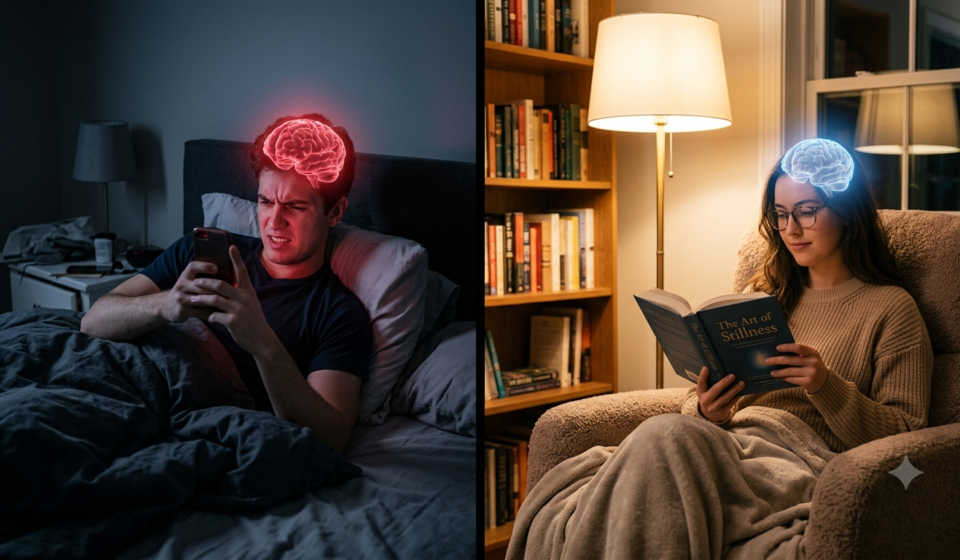
Blue light exposure suppresses melatonin production, delaying your body’s natural sleep signal. But there’s a second factor that gets less attention: the content itself. Scrolling work email, news, or stimulating content in the hour before bed keeps your brain cognitively engaged in a way that works against sleepiness regardless of the light involved — which is why can’t I sleep even when tired often gets worse specifically on nights with heavy pre-bed screen use, separate from the light issue alone.
5. Caffeine’s Longer-Than-Expected Half-Life
Caffeine has an average half-life of roughly 5–6 hours, meaning a 3 p.m. coffee can still have a quarter of its stimulant effect in your system at 9 p.m. — and individual metabolism varies significantly, with some people processing caffeine much more slowly than others due to genetic differences in liver enzyme activity. This is a commonly underestimated answer to why can’t I sleep even when tired for people who don’t consider afternoon caffeine a likely factor.
Read More: ProDentim Reviews and Complaints 2026 — What Other Articles Are Not Telling You
6. Anxiety and Racing Thoughts
Even without a specific identifiable worry, generalized anxiety can produce a racing, cognitively active mind at exactly the moment your body wants rest. This is a distinct mechanism from generic stress-driven hyperarousal — it’s more specifically about thought content and cognitive activation than pure physiological alertness, though the two frequently overlap and reinforce each other.
7. An Irregular or Inconsistent Sleep Schedule
Going to bed and waking up at different times day to day disrupts the very system meant to align your sleepiness with your intended bedtime. Sleep researchers consistently point to wake time — more than bedtime — as the stronger anchor for regulating this rhythm, which is part of why can’t I sleep even when tired shows up more on nights following an irregular schedule than on nights following a consistent one.
8. Undiagnosed Sleep Disorders
For a smaller subset of people, the honest answer to why can’t I sleep even when tired isn’t behavioral at all — conditions like delayed sleep phase syndrome, restless leg syndrome, or even underlying sleep apnea (which can fragment sleep without full wakefulness being obvious to the person experiencing it) can produce this exact pattern. If none of the behavioral explanations above seem to fit, or if this pattern has persisted for months despite consistent effort, that’s a reasonable point to bring it to a doctor rather than continuing to self-diagnose.
What Actually Helps
Based on the reasons above, a few approaches have the strongest evidence behind them:
Address hyperarousal directly. Breathing techniques like the 4-7-8 method work specifically on the physiological stress response, not just “relaxation” in a general sense — the extended exhale activates your parasympathetic nervous system.
Anchor your wake time, not just your bedtime. A consistent wake time, including weekends, is the more effective lever for realigning your circadian rhythm than trying to force an earlier bedtime alone.
Get morning light exposure. Roughly 10–15 minutes of outdoor light shortly after waking helps set your circadian clock, with downstream effects on melatonin release around 14–16 hours later.
Track your caffeine cutoff. Given the 5–6 hour half-life, a rough rule of no caffeine after early-to-mid afternoon addresses one of the more commonly missed contributors.
Use stimulus control if you’re lying awake. If you’re not asleep within roughly 20 minutes, get up and do something calm and low-stimulation rather than lying there frustrated — this is one of the core, evidence-based components of CBT-I (Cognitive Behavioral Therapy for Insomnia), the treatment approach with the strongest research support for chronic sleep-onset difficulty.
When to See a Doctor
If why can’t I sleep even when tired has been a near-nightly pattern for more than a few weeks, significantly affects your daytime functioning, or you notice signs like loud snoring, gasping during sleep, or leg discomfort specifically at night, these are reasons to talk to a doctor rather than continuing to troubleshoot alone. Sleep disorders like sleep apnea and restless leg syndrome are common, treatable, and not something behavioral techniques alone will resolve if they’re the actual underlying cause.
Frequently Asked Questions
Why do I feel exhausted all day but wide awake at night? This is the tired-vs-sleepy distinction described above: fatigue is a subjective energy state, while sleepiness is a distinct physiological drive governed by your circadian rhythm and sleep pressure. It’s possible to have high fatigue and low sleepiness at the same time, which produces exactly this pattern.
Can stress alone cause this even without a specific worry? Yes — chronic stress keeps your sympathetic nervous system and cortisol levels elevated at a time they should be dropping, producing a generalized hyperarousal state that doesn’t require a specific identifiable thought to keep you awake.
Is it normal for this to happen occasionally, or is it always a sign of a sleep disorder? Occasional nights like this are common and not usually a sign of an underlying disorder — travel, an irregular week, or unusual stress can all cause temporary versions of this pattern. It’s the persistent, near-nightly version, especially alongside other symptoms like snoring or leg discomfort, that’s worth a doctor’s evaluation.
Does napping make this worse? It can, particularly a late-afternoon or evening nap, since it releases some of the sleep pressure that’s supposed to build toward bedtime. Earlier, shorter naps (20 minutes, before mid-afternoon) are less likely to have this effect.
What’s the single most effective fix if I can only try one thing? Based on the research, anchoring a consistent wake time tends to have an outsized effect relative to how simple it is, since it’s the primary regulator of your circadian rhythm. Combined with a caffeine cutoff and morning light exposure, these three free changes address several of the most common underlying causes at once.
The Bottom Line
Why can’t I sleep even when tired usually isn’t about a lack of tiredness at all — it’s a mismatch between how exhausted you feel and whether your body’s actual sleepiness systems (circadian rhythm and sleep pressure) are aligned with the time you’re trying to sleep. Hyperarousal, circadian misalignment, late caffeine, screen exposure, and irregular schedules account for the large majority of cases, and each has a specific, addressable fix rather than requiring you to just “try harder” to relax. If you’ve addressed the common behavioral causes and the pattern persists for weeks despite consistent effort, that’s a reasonable point to involve a doctor rather than continuing to troubleshoot it alone.
This article is for informational purposes and reflects general sleep-science research. It is not medical advice. Consult a doctor if this pattern persists or is affecting your daily functioning.
why can’t I sleep even when tiredwhy can’t I sleep even when tired why can’t I sleep even when tiredwhy can’t I sleep even when tired